
Tutor, Not Solver: Designing a Guardrailed AI Assistant for Learning in Higher Education: A Design Case of PeteChat
arXiv preprint (cs.HC), 2026
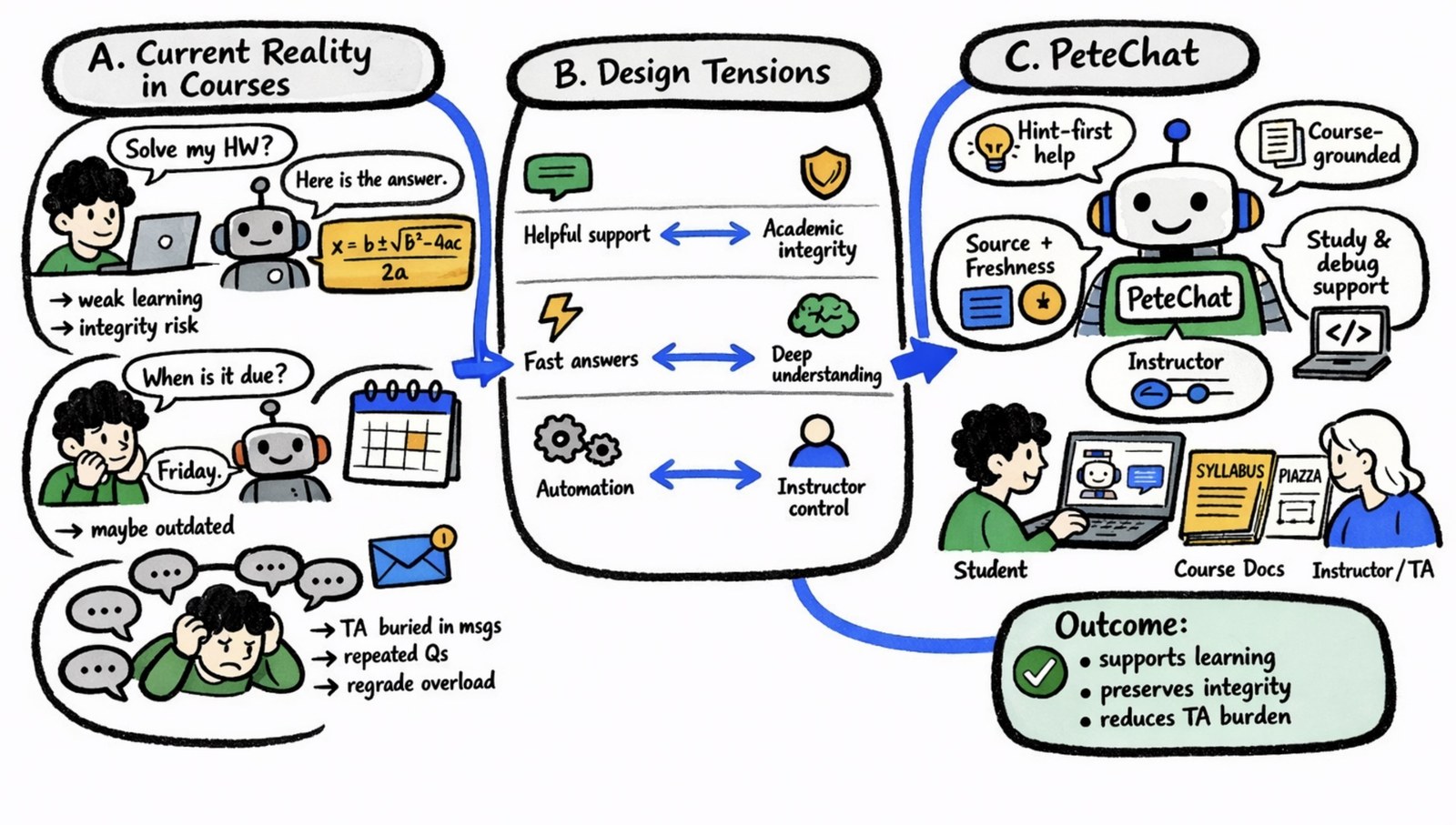 Figure 1. Motivating problems, core design tensions, and the conceptual positioning of PeteChat as a guardrailed, course-aligned tutor.
At a glance: 284 baseline messages · 31 conversations · 3 task contexts · κ = .82 · 4 expert sessions · 8 design decisions · 8 design principles
Links: arXiv:2606.09845 · PDF · Preprint, 16 pages, with appendices on interview protocol, second-prototype interface states, and baseline coding tables.
Abstract
Generative AI tutors hold significant promise for higher education, yet designing systems that scaffold learning without undermining academic integrity remains an open design challenge. This paper presents PeteChat, a course-aligned AI tutor developed and deployed at Purdue University, documented through the lens of design-based research (DBR). Drawing on literature-informed design inputs, a pre-deployment baseline analysis of authentic student-system interactions, and formative expert evaluation with teaching assistants and UX/developer stakeholders, we report eight transferable design principles for assessment-aware AI tutors: from homework guardrails and debugging scaffolds to self-regulated learning support and instructor-facing customization tools. The system is built on a locally hosted Llama-3 model enhanced with retrieval-augmented generation (RAG) grounded in course-specific materials. Rather than reporting controlled experimental outcomes, this design case foregrounds the situated design reasoning, iterative refinement, and principled decision-making that shaped PeteChat across multiple development phases. The resulting principles and methodological approach offer actionable guidance for institutions seeking to deploy responsible, integrity-preserving AI tutors at scale.
Index terms: generative AI; educational chatbot; design-based research; self-regulated learning; academic integrity; retrieval-augmented generation; higher education
Research Questions
- What design principles emerge for AI tutors that scaffold learning without undermining academic integrity?
- How can self-regulated learning (SRL) theory be operationalized in AI-mediated dialogue?
- What institutional constraints shape AI tutor design in practice?
Design-Based Research Across Four Phases
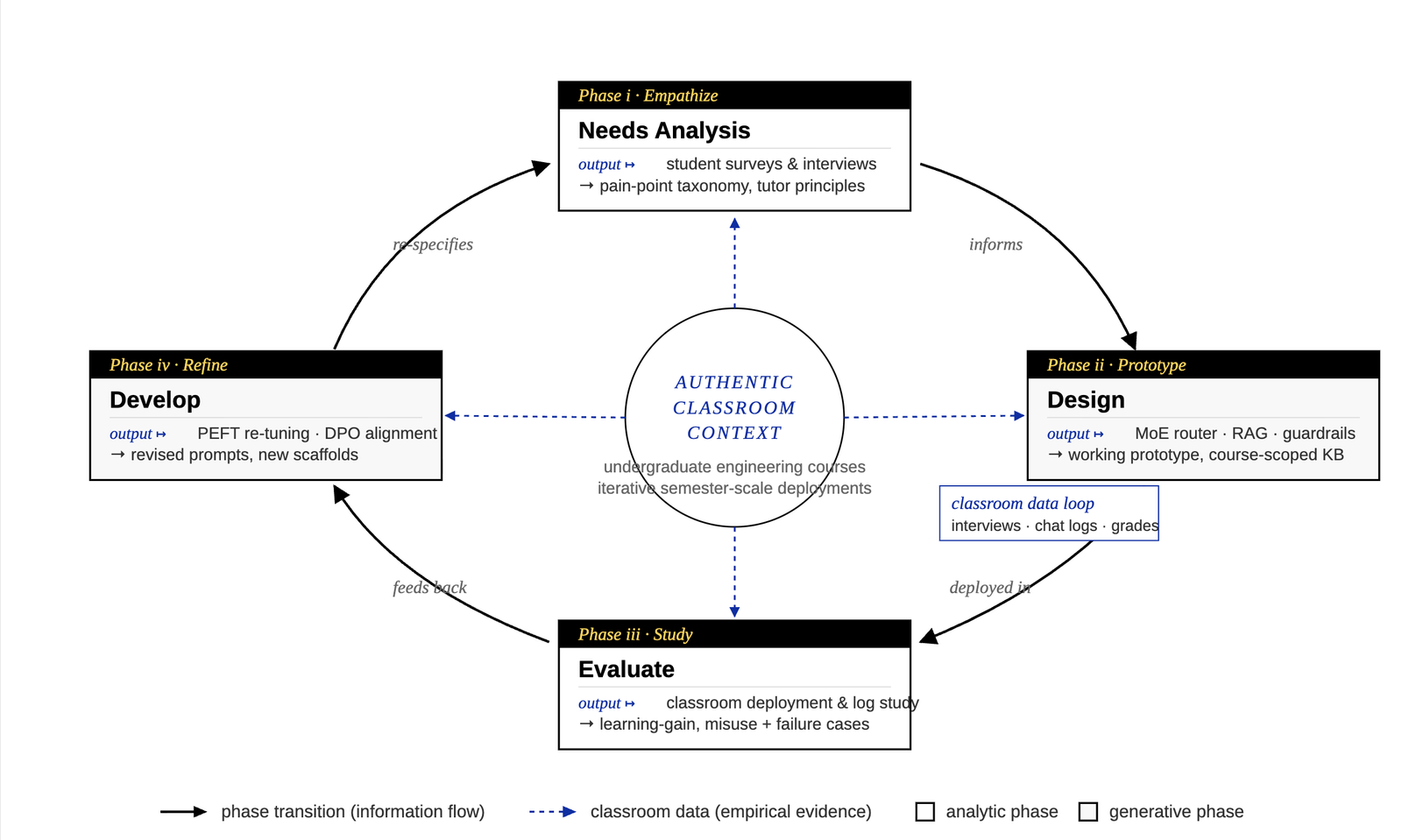 Figure 2. Needs analysis, design, evaluation, and development form an outer loop of information flow, while an inner classroom data loop feeds authentic usage evidence back to every phase.
The project is reported as a design case rather than an outcome study. Each semester of pilot use constituted one design cycle. Chronologically, the work unfolded in four project phases; the paper marks the DPO alignment and cross-course deployment phases as anticipatory (see Limitations).
| Phase | Period | Focus |
|---|---|---|
| 1 | Summer to Fall 2024 | Course-specific data collection, baseline tutor, fine-tuning of open-source LLMs (beginning with Llama-3) on Purdue’s Gilbreth cluster |
| 2 | Fall 2024 to Spring 2025 | First deployment to undergraduates in ECE 20875 through Gradio/Hugging Face |
| 3 | Spring to Summer 2025 | Direct Preference Optimization to align response style and scaffolding with student preferences |
| 4 | Spring 2026 | Extension to additional large undergraduate Python programming courses |
Evidence Base Before the Redesign
Before the guardrails and SRL scaffolds were built, the team analyzed all interactions logged during a pre-guardrail deployment in ECE 20875 (Fall 2025): 284 messages from 31 conversations across exam preparation, homework debugging, and an open-ended mini-project. Messages were coded with a dual-family scheme (10 student SRL codes grounded in Zimmerman’s three-phase model; 9 system-alignment codes). A second coder independently coded 60 messages (21.1% of the corpus), yielding Cohen’s κ = .82.
Three design pressures emerged:
- Boundary and answer control. Direct answer seeking appeared in 7.0% of student messages, and boundary testing reached 13.4% overall and 22.0% in the homework context. The baseline system sometimes complied with direct-solution requests.
- Grounding and freshness. Stale or incorrect course information appeared, and 29.6% of system output was generic or non-instructional.
- SRL visibility. Hint utilization was not observed, and self-evaluation appeared in only two messages (1.4%). SRL scaffolds therefore became a design necessity rather than a theoretical aspiration.
These pressures were then triangulated with four formative expert sessions (two ECE 20875 teaching assistants, one software developer, one UX designer; 45 to 60 minutes each; IRB approved). Teaching assistants reported that heavy reliance on generic AI tools such as ChatGPT was inflating homework scores (often above 95%) while exam performance dropped, that unjustified regrade requests were a major time sink, and that students “are not reading anymore.”
System Architecture
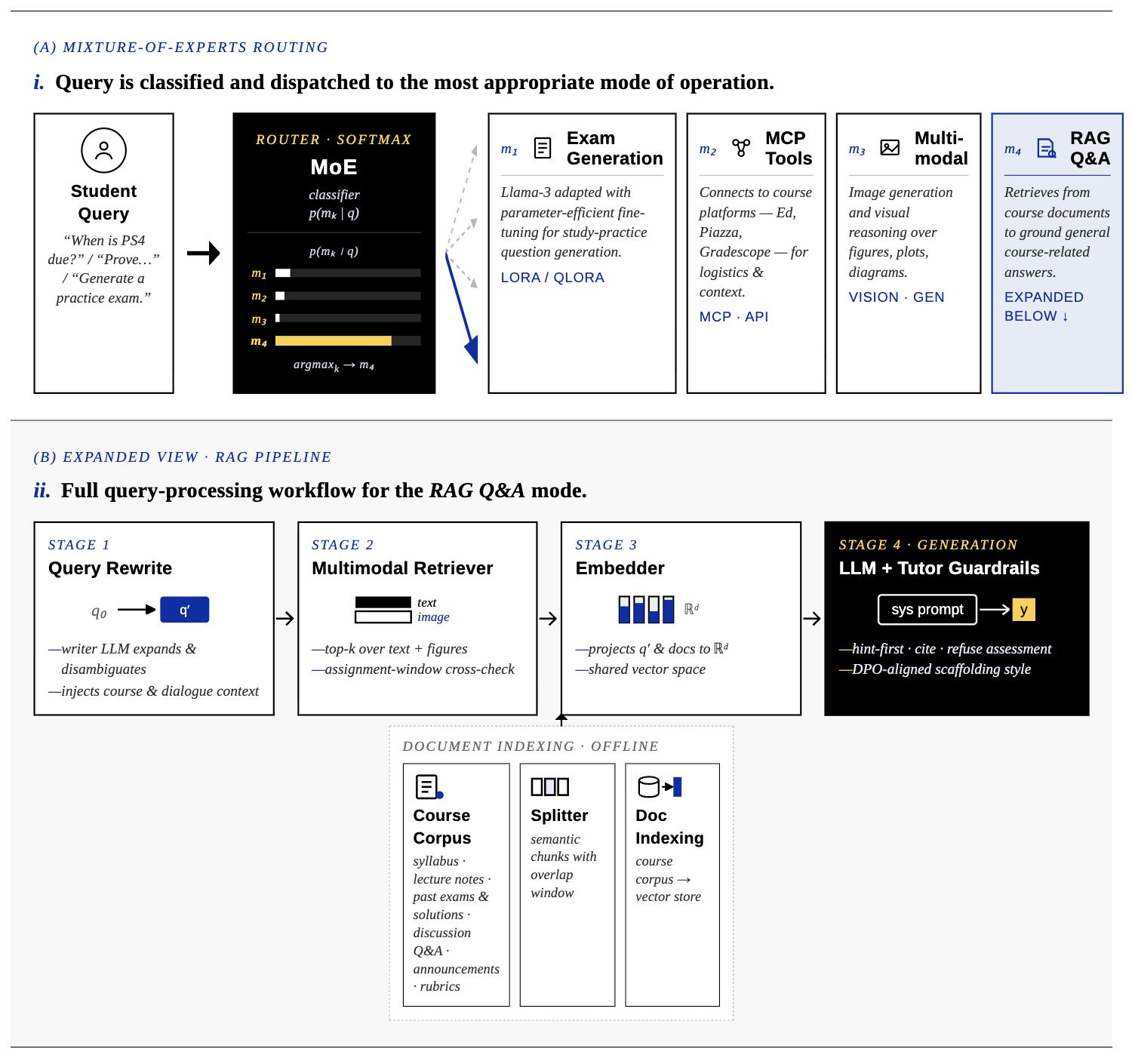 Figure 4. A mixture-of-experts-inspired router dispatches each query to exam generation, MCP tools, multimodal support, or RAG question answering. The RAG pipeline includes query rewriting, multimodal retrieval, shared-vector embedding, and generation under tutor guardrails.
PeteChat runs on a locally hosted Llama-3 model, fine-tuned with parameter-efficient methods (LoRA/QLoRA) on syllabi, lecture notes, prior exams and solutions, and discussion-board Q&A shared with faculty permission. Course data are not exported for third-party fine-tuning. A continuously updated knowledge base supplies current announcements and clarifications, and the model is prompted to cite retrieved course sources and to express uncertainty rather than fabricate.
Eight Design Principles
The principles emerged from the synthesis of the expert-session findings; each is tied to specific design decisions in the paper, several of which also draw on the baseline analysis. Principle wording follows Section XI of the paper.
| Principle | What PeteChat does |
|---|---|
| 1. Tutor, not solver | Default to hints and scaffolding and avoid direct answers; teach how to think through debugging explanations and step-by-step reasoning |
| 2. Align to the course | Ground responses in instructor-provided materials, show provenance, add freshness disclaimers for logistics |
| 3. Respect academic integrity | Guardrails and integrity reminders on homework; encourage students to read and follow instructions |
| 4. Reduce TA overhead | Instruction summaries, rubric-based regrade explanations before escalation, and consistent answers to repeat questions |
| 5. Design for clarity and momentum | Default-open sidebar with “Try asking…” prompts per assignment; concise, readable, visual answers |
| 6. Flexible control for staff | Instructor upload slots, per-course tone settings, alignment metrics without code |
| 7. Trust through transparency | Show sources, note uncertainty, offer share/confirm actions for verification with peers or TAs |
| 8. Time-aware support | Study planners and mock quizzes scoped to available time and upcoming exams |
Limitations
The evidence base is formative rather than outcome validating: one course at one R1 university, one semester of baseline data, and four expert evaluators who overlap with the design team, which the authors note raises the potential for self-report bias; transferability remains to be tested. The SRL-aligned features are theoretically motivated but not yet validated against learning outcomes. Hallucination risk persists even with RAG grounding, and claims about the later phases (DPO alignment, cross-course deployment) are anticipatory pending dedicated reporting.
Related Work on PeteChat
An invited Springer book chapter (in press), From Answer Bot to Course Tutor, presents the practice-oriented design case for the same system. A related presentation, “A Design Case of PeteChat: Designing AI Tutors That Teach Students How to Think, Not What to Answer,” is scheduled for the AECT International Convention, Chicago, October 2026.
Recommended citation: Li, B., *Tan, L., Zakharov, W., Qiu, Q., & Acton, C. B. (2026). Tutor, not solver: Designing a guardrailed AI assistant for learning in higher education: A design case of PeteChat. arXiv. https://arxiv.org/abs/2606.09845
Download Paper